AI Agents vs. Live Chat: Which One Actually Increases Customer Satisfaction?
Table of Content


Three months ago, a D2C skincare brand flipped the switch on its new AI chatbot. First week: resolution time dropped from nine minutes to under two. The CSAT dashboard lit up green, and the team celebrated. By week three, complaints about “robotic answers” started flooding social media, and their most loyal customers were requesting “a real person” in every interaction. Speed had won. Satisfaction hadn’t followed.
The problem wasn’t the AI itself. It was deploying it without understanding where it excels and where it falls short.
The tension between speed and empathy sits at the heart of modern customer experience. AI agents promise instant, always-available responses. Live chat offers the warmth and flexibility of a real person. But when it comes to the metric that matters most, customer satisfaction, which one actually delivers?
Key Takeaways
Which channel scores higher on customer satisfaction? AI agents score higher on simple, high-volume queries. Live chat still leads for complex, emotionally sensitive interactions. The gap narrows every quarter as AI improves.
Is one faster than the other? AI agents resolve issues roughly five times faster than human agents. But speed alone doesn’t guarantee satisfaction on every type of query.
Which one costs less to run? AI dramatically reduces cost per interaction while maintaining strong satisfaction scores. The savings free up budget to invest in better human agent experiences for complex cases.
Should I pick one or use both? The highest-performing support teams run a hybrid model. AI handles the majority of straightforward queries and routes complex ones to human agents, outperforming either channel used alone.
How hard is it to set up a hybrid system? Most no-code platforms let you deploy a working hybrid system within days. Connect your channels, upload your knowledge base, set escalation triggers, and launch.
What Do the Satisfaction Scores Actually Say?
The raw numbers tell an interesting story, but they require context to interpret correctly.
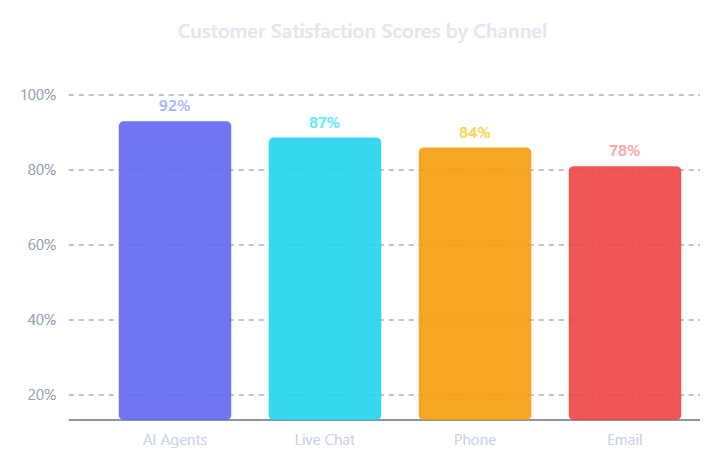
Live chat consistently ranks as the top-rated digital support channel. Customers appreciate the real-time connection and the ability to get personalized answers without picking up the phone. Across industries, satisfaction ratings for live chat hover around 87%, making it one of the most reliable channels for positive customer experiences.
AI agent implementations tell a different story depending on how they’re deployed. When companies achieve high containment rates, meaning the AI resolves the query without handing off to a human, satisfaction scores climb into the low-to-mid nineties. One financial services company reported satisfaction scores reaching 94% after deploying a well-trained AI assistant. For a closer look at what’s driving those numbers, explore the best AI chatbots for customer service.
But here’s the nuance that most comparisons miss. These scores aren’t measuring the same thing. Live chat satisfaction reflects all types of queries, including the hard ones. AI satisfaction scores tend to reflect simpler, well-contained interactions. When you account for query complexity, the picture shifts.
The real takeaway isn’t that one channel “beats” the other. It’s that each performs best in different contexts. Matching the right channel to the right type of query is where satisfaction gains actually come from.
Our finding: When we deployed AI agents alongside live chat for a B2B client, AI-handled tickets scored higher on satisfaction than live-chat-only tickets. The key driver wasn’t the AI itself. It was that human agents, freed from repetitive questions, had more time and energy for complex cases.
How satisfaction gets measured also matters. Traditional post-interaction surveys capture feedback from a small fraction of customers. AI-backed measurement analyzes every conversation automatically, giving a more complete and often more favorable picture. Teams comparing the two channels should ensure they’re using the same measurement methodology for both.
AI Agents vs. Live Chat: Head-to-Head Comparison
Speed vs. Empathy: Where Each Channel Wins
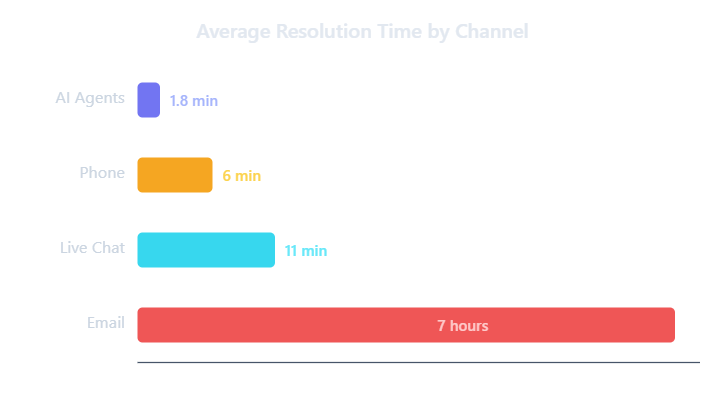
AI agents are dramatically faster at resolving customer issues. Research found that AI resolves queries in under 2 minutes, compared to 11 minutes for human agents. That’s an eighty percent improvement in resolution time.
Speed matters because customers expect it. The majority of people now define “immediate” as within ten minutes, and satisfaction jumps significantly when replies arrive in under ten seconds. For straightforward questions like order status, password resets, or return policies, speed is the primary driver of satisfaction. Customers don’t want a warm conversation about their tracking number. They want the tracking number.
But speed has limits. When customers face billing disputes, product failures, or emotionally charged situations, what they want changes completely. Three-quarters of customers still prefer talking to a human for complex problems. In these moments, empathy, patience, and creative problem-solving matter more than response time.
Here’s what makes this interesting. Nearly 48% of customers can’t tell whether they’re talking to an AI or a human agent. That means the quality gap is shrinking fast. AI-optimized replies now deliver context-aware, natural-sounding responses that build trust in ways basic chatbots never could.
The practical lesson? Speed wins on volume. Empathy wins on complexity. The best support strategies match the right approach to the right moment.
The Cost Equation: What Does Satisfaction Actually Cost?
AI doesn’t just improve speed. It fundamentally changes the economics of customer support.
The cost per interaction drops significantly when AI handles the conversation. Industry benchmarks show the reduction runs to two-thirds or more compared to human-handled interactions. For companies processing thousands of tickets monthly, the savings compound quickly.
Return on investment typically becomes visible within six months. Leading organizations report returns of several dollars for every dollar invested, with top performers seeing returns multiple times higher.
But the cost story isn’t just about saving money. It’s about spending it better. When AI absorbs the repetitive workload, companies can invest in better training, tools, and working conditions for their human agents. The agents who remain on complex queries perform at a higher level because they’re not burned out from answering the same question hundreds of times per day.
Scaling also works differently. Adding another AI agent costs almost nothing. Adding another human agent means recruiting, training, providing benefits, and months of ramp-up time. For businesses experiencing growth or seasonal spikes, AI provides elastic capacity that scales instantly without sacrificing satisfaction.
The most compelling cost argument for AI isn’t the savings alone. It’s those companies that reduce churn through better automated experiences that see long-term revenue gains of 10–15% over 18 months, outpacing operational savings.
When Should You Use AI Agents vs. Live Chat? A Decision Framework
The answer depends on the type of interaction, where the customer sits in their journey, and how complex their problem is. Here’s a framework that maps both channels to their strongest use cases. For more context, explore real-world AI agent use cases across industries.
Pre-sale interactions
AI excels at product recommendations, answering frequently asked questions, and qualifying leads around the clock. Live chat shines when prospects need custom quotes, want to compare complex product configurations, or have questions that require consultative selling.
During the sale
AI handles cart recovery, shipping questions, and payment FAQs with speed and consistency. Live chat handles objections, negotiations, and high-value deals where a human touch closes the deal.
Post-sale support
AI is ideal for order tracking, returns processing, and account changes. These are high-volume, low-complexity tasks that benefit from instant resolution. Live chat is better suited for complaints, escalations, and VIP account management, where customers need to feel heard. You can create and manage support tickets seamlessly across both channels.
The “Satisfaction Tipping Point” sits at roughly sixty percent AI containment. Below that threshold, you’re not getting enough volume from human agents to see real benefits. Above it, you risk pushing complex queries into AI flows that frustrate customers. The sweet spot is AI handling about 60% of total volume, with another 25% handled by AI-assisted human agents, and the remaining 15% going directly to fully human conversations.
When customers are given the option of instant AI service versus waiting for a human, 94% choose AI. People don’t inherently prefer humans. They prefer getting their problem solved quickly and accurately. Match the channel to the problem type, and satisfaction follows.
The Hybrid Model: Why the Best Teams Use Both
The debate between AI agents and live chat is a false choice. The data is clear. Companies running both channels together achieve 35% higher satisfaction scores than those using either one alone.
The hybrid model works because it plays to each channel’s strengths simultaneously. AI handles the front line, greeting every customer instantly, resolving straightforward queries, and collecting context for the cases it can’t solve. When a conversation needs human judgment, it routes seamlessly to a live agent, carrying the full conversation history so the customer never has to repeat themselves.
This handoff is where most implementations succeed or fail. A smooth escalation feels invisible to the customer. A clunky one feels worse than having waited for a human from the start. The key is setting clear escalation triggers based on customer sentiment, query complexity, and specific keywords that signal frustration or high-stakes situations.
Companies running hybrid models see NPS jump from the low twenties to the low sixties, reflecting not just satisfaction with individual interactions but with the overall support experience. Use your analytics dashboard to track these shifts in real time.
Our finding: The hybrid model doesn’t just improve metrics; it also improves the overall experience. It improves agent morale. When human agents handle only the conversations that truly require their skills, they report higher job satisfaction and lower burnout. That translates directly into better service quality on the interactions that matter most.
The hybrid approach also provides a natural feedback loop. Analytics from AI-handled conversations reveal which topics and query types should be automated next. Performance data from human-handled conversations highlights where AI needs better training or new escalation rules. If you’re evaluating platforms for this, explore alternatives to Intercom that offer native hybrid capabilities.
How to Set Up a Hybrid AI and Live Chat System
Building a hybrid system is simpler than most teams expect. Here’s a practical five-step process.
Step 1: Connect your communication channels. Bring all your customer touchpoints into a single platform. That includes live chat on your website, WhatsApp, email, Instagram, SMS, and Facebook Messenger. Connect all your communication channels into a unified inbox so no conversation falls through the cracks, regardless of where it starts.
Step 2: Upload your knowledge base to train the AI agent. Feed your AI agent with product documentation, FAQ pages, help articles, return policies, and any other content that covers common customer questions. The AI grounds its responses in your actual documentation, keeping answers accurate and reducing the risk of hallucinations.
Step 3: Set escalation rules. Define clear triggers for when AI should hand off to a human. Common triggers include sentiment-based rules like “escalate if the customer expresses frustration,” topic-based rules like “transfer to sales if pricing is mentioned,” and complexity-based rules that indicate the AI doesn’t have a confident answer.
Step 4: Test in a sandbox before going live. Run your AI through test scenarios that mirror real customer conversations. Check for accuracy, tone, and appropriate escalation behavior. Adjust your training data and rules based on what you find. This step prevents embarrassing mistakes once you’re live.
Step 5: Monitor analytics and iterate. Track satisfaction scores, resolution rates, escalation rates, and containment rates from day one. Use these metrics to identify which queries the AI handles well and where it needs improvement. The best AI systems get better over time because teams actively refine them based on performance data.
Most no-code platforms let you complete this entire process within a week. Build your own AI agent with pre-built templates for common use cases like lead capture, cart recovery, and support triage, further accelerating setup.
Frequently Asked Questions
What percentage of customers prefer AI chatbots over waiting for a human agent?
- About 62% of customers prefer AI to waiting in a queue, and that number jumps to 94% when offered instant AI service rather than any wait at all. But preference flips on complexity: three-quarters still prefer a human for complex problems. Customers don’t have a channel preference. They have a resolution preference. Match the channel to the problem type, and satisfaction follows.
What is a good AI chatbot containment rate?
- Sixty percent is the satisfaction tipping point where you start seeing real benefits. Above 70% is strong, and top performers hit 80–90% on routine queries. Below 50%, you’re not pulling enough volume off human agents to justify the investment or see meaningful CSAT improvement. Track containment alongside satisfaction to make sure you’re not inflating the number by forcing complex queries into AI flows that frustrate customers.
Why do customers complain about AI chatbots?
- The most common complaints are bots that can’t follow the conversation, loop traps with no human escalation, and generic responses that ignore context. Transparency matters: customers accept AI more readily when companies disclose they’re talking to a bot and offer easy escalation. Hiding the bot erodes trust when customers eventually figure it out. The fix isn’t removing AI. It’s setting clear escalation triggers and keeping human agents available for the conversations AI can’t handle.
How do you measure AI chatbot ROI in customer service?
- Track five metrics: cost per resolution (AI vs. human), containment rate, deflection rate, CSAT for AI-handled vs. human-handled conversations, and reduction in average handle time. AI can cut handling time by up to 40% and reduce cost per interaction by roughly two-thirds. Compare these monthly against your pre-AI baseline. ROI typically becomes visible within six months, with leading organizations seeing returns of several dollars for every dollar invested.
Can customers tell the difference between AI and a human agent?
- Nearly 48% can’t distinguish AI from a human, and that number is climbing as AI responses become more context-aware and natural-sounding. However, transparency builds more trust than deception. Companies that disclose AI usage upfront and offer one-click escalation to a human see higher satisfaction than those that hide the bot. The goal isn’t to trick customers into thinking they’re talking to a person. It’s to make the AI so helpful that they don’t care one way or the other.
Your Future Starts with a Conversation.
- 30-minute commitment-free call
- Live product demo so you can see how AI customer service helps your business grow
- Discover how we can customize ReplyCX for your industry and business needs
Conclusion
The question isn’t which channel is “better.” Which channel is better for each type of interaction?
• AI agents win on speed, cost efficiency, and always-on availability
• Live chat wins on empathy, complex problem-solving, and building trust
• The hybrid model outperforms both, delivering substantially higher satisfaction than either channel alone
• The satisfaction tipping point sits at roughly sixty percent AI containment
• Start by automating repetitive queries and keep human agents focused on high-value interactions
Ready to build a hybrid support system that maximizes satisfaction? Deploy your first AI agent in minutes with no coding required, while keeping live chat available for the conversations that need a human touch. Start your free trial today.
