

Last quarter, a VP of Support got budget approval to double her team from 10 to 20 agents. Six months later, costs had nearly tripled. The salary line looked right. The software line looked right. But somewhere between recruiting, training, backfilling, tool licenses, and a wave of agent departures nobody saw coming, the budget was already blown by month four.
Nobody could explain exactly where the money went. That's because the highest costs of scaling a support team aren't the ones that appear on a line item. They're the ones hiding underneath.
Salaries and software are the tip of the iceberg. The real budget killers, turnover, training ramp, tool sprawl, coordination overhead, quality regression, and coverage gaps, are the ones nobody plans for until they've already hit. This article maps every hidden cost that appears when you grow a support team, with real benchmarks, so you can budget for what scaling actually costs.
Key Takeaways
What's the highest hidden cost of scaling support?
- Turnover. Replacing a single agent costs tens of thousands of dollars when you factor in recruiting, training, and lost productivity.
Why does support get MORE expensive as you grow?
- Every doubling of team size brings coordination overhead, tool sprawl, quality variance, and management layers that grow faster than headcount.
Can AI actually reduce these costs?
- Yes, but only when used to absorb volume, not to replace judgment. Teams using AI for routine queries handle significantly more volume without proportional headcount growth.
Where should I start auditing my hidden costs?
- Track your cost per ticket, repeat contact rate, agent tenure, and time-to-productivity. The gaps between what you budget and what you actually spend will become clear.
What Does It Actually Cost to Scale a Support Team?
Staffing alone absorbs roughly two-thirds of a support team's entire operating budget. That's the part everyone knows about and plans for. But once you add the costs that don't appear on any spreadsheet, the true figure jumps significantly.
The visible costs are straightforward: agent salaries, benefits, software licenses, equipment, and office or remote infrastructure. These are the line items that show up in every budget approval. They're real, they're predictable, and they're only half the story.
The hidden costs sit underneath. Turnover cycles that drain recruiting and training budgets every few months. Quality dips during growth sprints when new hires haven't ramped up yet. Shadow tools that agents adopt on their own because the official stack doesn't cover their needs. Coordination meetings multiply as the team grows. Coverage gaps during hiring cycles push response times up and customer satisfaction down.
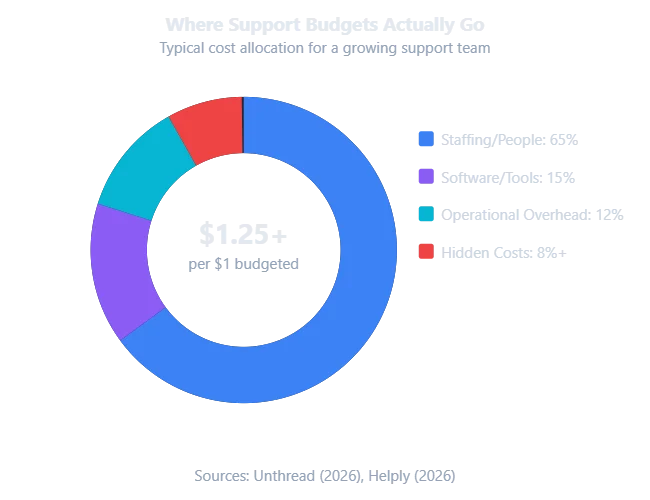
For every dollar you budget to scale your support team, expect to spend somewhere between $1.25 and $1.50 once these hidden costs are factored in. The companies that get blindsided are the ones that plan for headcount and software but forget everything else.
The 7 Hidden Costs Nobody Budgets For
The gap between what companies budget for support scaling and what they actually spend typically runs between a quarter and nearly half of the original figure. Most of that gap comes from costs that never appear on a single line item.
The People Costs
1. Turnover and replacement cycles. Agents leave, and replacing them costs far more than their salary alone. Contact centers lose 30 to 45% of their workforce annually, with average tenure hovering around 13 to 15 months. Recruiting, onboarding, training, and the productivity gap during ramp-up all add together. This isn't a one-time expense. It's a recurring drain that resets every time someone walks out the door.
2. The training ramp. New hires take 60 to 90 days to reach full productivity. During that window, they handle fewer tickets, need more supervision, and make more errors. For a growing team constantly backfilling, a meaningful portion of the headcount is always in ramp mode. You're paying full salaries for partial output.
3. Burnout-driven quality decline. When volume outpaces hiring, existing agents absorb the overflow. 87% of agents report their job causes stress, and over 60% cite it as the primary reason they leave. Satisfaction scores drop. Repeat contacts spike. Each repeat contact is a hidden cost that doesn't appear anywhere in the budget.
The Operational Costs
4. Tool sprawl and shadow IT. Every new channel, integration, and software license adds cost. But the bigger expense is the tools agents adopt on their own: browser extensions for note-taking, personal spreadsheets for tracking follow-ups, and messaging apps for side conversations. This "shadow tooling" creates data silos, introduces security risks, and gives managers zero visibility.
5. Coordination overhead. A five-person team can function on a chat app and shared documents. A twenty-person team needs shift schedules, team leads, quality assurance processes, and escalation protocols. These management layers don't scale linearly with headcount. They scale faster.
6. Knowledge loss. Every departing agent takes institutional knowledge with them. Product quirks that aren't documented. Customer preferences that only exist in someone's head. Workaround solutions that never made it into the knowledge base. The remaining team has to rediscover answers to problems that were already solved.
7. Revenue impact of service gaps. During every hiring cycle, there are coverage gaps. Longer hold times, slower email responses, missed SLA targets. A customer who left because their issue sat unanswered for three days during a hiring sprint? That loss shows up in the revenue report, not the support budget. But the cost was escalating all along.
Why Does Support Get More Expensive as You Scale?
The majority of customer service practitioners say managing ticket volumes without growing headcount is their top challenge heading into 2026. The reason costs outpace growth is structural: scaling support isn't linear.
The Scaling Tax is the phenomenon where the total cost of running a support operation grows faster than headcount because of coordination complexity, management layers, and compounding hidden costs at each stage of growth.
The Scaling Tax in practice: Here's how the math actually works when you double a support team. You double the salary line, but you also add management layers, expand tool licenses, increase coordination meetings, layer in more QA overhead, and start backfilling turnover at a faster rate. The net result: doubling your headcount typically costs you roughly two and a half to three times your original budget, not two times.
Why does this happen? Because every new person on the team adds communication channels. A ten-person team has 45 unique communication links between members. A twenty-person team has 190. That's not a linear increase. It's an exponential one.

What Does a Support Agent Actually Cost?
The average support agent salary in the US sits between $35,000 and $40,000 per year. That's the number most managers use when planning headcount expansion. But the loaded cost of that same agent lands somewhere between $55,000 and $80,000 annually.
What You Budget vs. What You Actually Spend Per Agent
| Cost Category | Annual Range |
|---|---|
| Base salary | $35,000 to $40,000 |
| Benefits and payroll taxes | $10,000 to $15,000 |
| Software and tools | $2,400 to $14,400 |
| Training (initial + ongoing) | $1,000 to $2,000 |
| Equipment (laptop, headset, monitors) | $500 to $2,000 |
| Recruiting cost (amortized per hire) | $2,500 to $5,000 |
| Management allocation | Variable |
| Total loaded cost | $55,000 to $80,000 |
The salary is often only half to sixty percent of the true cost. Everything else compounds silently in the background. And for fast-growing teams with high turnover, the recruiting and training costs repeat multiple times per year for the same seat.
What we've seen: Based on patterns across hundreds of support operations, the businesses that track loaded cost per agent rather than base salary consistently discover their true spend running 40 to 60% above what the HR budget suggests. That gap between budgeted and actual cost is exactly where the hidden costs accumulate.
How Does AI Change the Scaling Equation?
AI-assisted agents resolve issues significantly faster and achieve higher first-contact resolution rates than unassisted ones. That finding matters because it directly addresses the core scaling problem: the linear relationship between ticket volume and headcount.
AI changes the math in three specific ways:
- Volume absorption. An AI-powered chatbot handles the routine, high-frequency queries at a fraction of the cost. This means you need fewer agents per unit of volume, which compresses the headcount expansion that drives most scaling costs.
- Faster ramp-up. When AI provides suggested responses, pulls customer history, and surfaces relevant knowledge base articles, new hires reach full productivity faster. The two-to-three-month training ramp gets compressed because the system fills the experience gap.
- Reduced turnover. When automation absorbs the repetitive, mentally draining work, agent satisfaction improves. The tasks that remain are more complex, more varied, and more rewarding. That directly reduces the burnout that drives the turnover cycle.

But there's an important warning. Industry analysts predict that a significant share of companies that cut support staff purely because of AI will end up rehiring within two years. The point of AI isn't to eliminate people. It's to break the linear relationship between volume and headcount so you can grow capacity without proportionally growing costs. Explore real-world AI agent use cases to see how this works in practice.
What Should You Actually Budget For?
The support teams with the most accurate budgets don't plan for two categories. They plan for four. Track everything through your support analytics dashboard to see where the money actually goes.
The True Cost Budget Framework
| Category | % of Budget | What It Covers |
|---|---|---|
| People Costs | 60-70% | Salaries, benefits, recruiting pipeline, training programs, and a backfill buffer for turnover |
| Technology | 15-20% | Software licenses, AI tools, integrations, configuration, and ongoing maintenance |
| Operations | 10-15% | Management, QA, compliance, workspace, and coordination that keeps a growing team aligned |
| Hidden Cost Buffer | 10-15% | Turnover replacements, quality regression during growth, shadow tooling cleanup, and service gaps |
That hidden cost buffer is the line item that most budgets don't have, and it's the one that makes the biggest difference. If you've never done this before, start by tracking cost per ticket, agent tenure, and repeat contact rate for a single quarter. The gaps between what you budgeted and what you actually spent will tell you exactly how large this buffer needs to be.
How Do You Scale Without the Cost Spiral?
The companies that scale support efficiently don't simply add headcount in proportion to ticket volume. They restructure how the work gets done.
- Automate tier-1 first. Route the repetitive, high-volume queries to chatbots and self-service portals. This is where the biggest cost savings live.
- Invest in agent tools, not just agent headcount. AI-assisted responses, instant knowledge base access, and automated routing make each agent handle more conversations without burning out.
- Track hidden costs explicitly. Add turnover cost, training ramp time, and repeat contact rate to your reporting dashboard. What gets measured gets managed.
- Build a knowledge base that grows with your team. Every resolved ticket should feed back into your documentation. This reduces the knowledge loss that happens when agents leave.
- Set up a structured ticketing system before you need one. By the time you're drowning in a shared inbox, you've already lost data, context, and customers.
- Use an omnichannel platform to consolidate. One system for all channels eliminates tool sprawl, reduces context switching, and gives managers full visibility.
Conclusion
Scaling a support team costs more than anyone budgets for. The salaries are the easy part. Everything else, the turnover cycles, the training ramp, the tool sprawl, the coordination overhead, the quality dips, and the revenue lost during coverage gaps, is what actually breaks the budget.
Contact centers lose 30 to 45% of their workforce annually, new hires take 60 to 90 days to reach full productivity, and 87% of agents report their job causes stress. These aren't edge cases. They're the baseline reality of running a growing support operation.
The Scaling Tax means that every doubling of headcount carries roughly two and a half to three times the total cost increase, not two times. The companies that scale efficiently recognize this pattern early and invest in systems that reduce coordination costs, absorb routine volume through AI, and build a knowledge base that survives agent departures. They budget for four categories, not two, and they add a hidden cost buffer to every plan. The ones that don't recognize it keep adding headcount and wondering why the budget keeps breaking.
Want to see where your support costs are actually going? Start a free trial and discover what structured support operations look like before your next scaling sprint.
Frequently Asked Questions
Why does doubling a support team cost nearly triple the original budget?
Because headcount is the only cost that doubles, when you go from 10 to 20 agents, you also add management layers, expand tool licenses, increase coordination meetings, layer in more QA processes, and start backfilling turnover at a faster rate. A ten-person team has 45 unique communication links between members. A twenty-person team has 190. Every additional person adds handoff points, decision nodes, and communication channels that compound the complexity and cost of running the operation. That's the scaling tax, and it's why total cost grows roughly 2.5 to 3 times when headcount merely doubles.
What is the loaded cost of a support agent vs. their base salary?
The average support agent base salary in the US is $35,000 to $40,000 per year. But once you add benefits, payroll taxes, software licenses, training, equipment, recruiting costs, and management allocation, the loaded cost lands between $55,000 and $80,000. That means the salary is only 50 to 60% of what the agent actually costs. For teams with high turnover, the recruiting and training line items repeat multiple times per year for the same seat, pushing the effective loaded cost even higher.
How long does it take a new support agent to reach full productivity?
Industry data shows new hires take 60 to 90 days to reach full productivity. During that window, they handle fewer tickets, need more supervision, and make more errors that require correction. For a team that's simultaneously backfilling departures and adding new roles, a meaningful portion of the headcount is always in ramp mode. The cost isn't just the training program itself. It's the full salaries you're paying for partial output during those two to three months, multiplied by every new hire cycling through.
What is shadow IT in customer support, and why does it matter?
Shadow IT refers to the tools agents adopt on their own to fill gaps the official stack doesn't cover: browser extensions for note-taking, personal spreadsheets for tracking follow-ups, and messaging apps for side conversations with teammates. It matters because it creates data silos (customer context trapped in personal tools), introduces security risks (sensitive data in unmonitored apps), and gives managers zero visibility into how work actually gets done. The bigger and faster-growing the team, the more shadow tooling proliferates, because the official stack can't keep up with the needs of a rapidly scaling operation.
What percentage of a support budget should be set aside as a hidden cost buffer?
10 to 15% of the total budget. This buffer absorbs the costs that never appear on a line item but always appear in the final spend: turnover replacements mid-cycle, quality regression during growth sprints, shadow tooling cleanup, and service coverage gaps during hiring cycles. If you've never allocated a hidden cost buffer before, start by tracking cost per ticket, agent tenure, and repeat contact rate for one quarter. The gap between what you budgeted and what you actually spent will tell you exactly how large this buffer needs to be for your operation.