Stop the "Growth Tax": Why Flat-Fee Pricing Beats Per-Seat for Customer Service
Table of Content


You need to add three agents to handle the holiday surge. But before you can hire, you check the math on your support platform. Three new agents mean three new seats. That's hundreds more per month in software alone, before salary and before training. So you don't hire. And your customers wait.
This is what per-seat pricing does to growing support teams. It creates a hidden tax on growth. Every time you scale your team to serve customers better, your software bill scales with it. The platform profits from your headcount, not from the value it delivers to your customers.
Flat-fee pricing flips that equation. Your cost stays fixed regardless of how many agents you add. Your per-agent cost actually drops as your team grows, the exact opposite of what happens with per-seat models.
This guide breaks down flat-fee vs. per-seat pricing across cost, scalability, and AI readiness, so you can choose the model that grows with your team instead of against it.
Key Takeaways
What is the "growth tax" in per-seat pricing? Every new agent you add multiplies your software cost. Your team grows, your bill grows faster. You're punished for scaling the very thing that improves customer experience.
Is flat-fee pricing actually cheaper? For growing teams, almost always. Your cost stays fixed regardless of how many agents you add, so the per-agent cost drops as your team expands.
Don't you lose flexibility with a flat fee? No. The best flat-fee platforms still offer tiered plans based on features. You just don't get penalized for headcount within your plan.
What about AI costs on top of per-seat? That's where it gets worse. Many per-seat platforms now charge separately for AI features, either per agent or per resolution, compounding the growth tax.
Who should consider switching? Any team planning to add agents in the next year, especially if you're paying for seats you don't fully use or avoiding new hires because the software cost per head is too high.
How Does Per-Seat Pricing Actually Break Down?
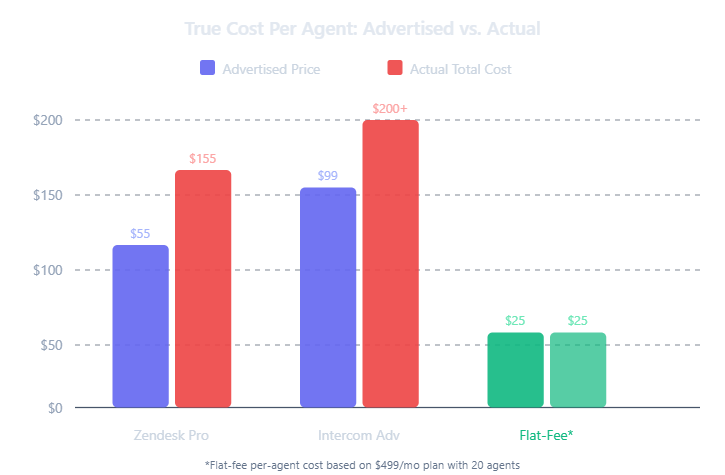
The advertised per-seat price is rarely the actual cost. Real-world costs are typically two to three times higher than the base rates once you add AI features, analytics, and integrations.
Take a popular per-seat platform. The entry-level plan looks affordable. But that plan only covers basic ticketing. Want to chat? That's a higher tier. Want AI-assisted replies? That's a per-agent add-on. Want an AI-powered chatbot resolution? That's $0.99 per resolution on top of everything else, and there's no cap. Cost stacking is where teams get caught. A mid-tier plan charges per agent per month as the base. Then the AI copilot add-on costs more per agent per month. Then the AI chatbot costs per resolution, billed automatically with no cap and no warning, since January 2026. A team that started at what looked like a reasonable monthly spend ends up paying multiples of that once they've turned on the features they actually need.
How does that look at scale? A mid-size support operation on per-seat platforms can reach six figures annually in software costs alone. And that doesn't include implementation, training, or the time your team spends navigating overage bills and contract escalation clauses.
Our finding: When we analyzed support teams switching from per-seat to flat-fee pricing, the most common pattern was that they had been limiting agent count to control costs, not because their support load had decreased. The software pricing was actively suppressing their ability to serve customers well.
The best Intercom alternatives are increasingly those that decouple cost from headcount entirely.
What Does Flat-Fee Pricing Look Like for Customer Service?
Flat-fee pricing charges a single fixed price regardless of how many agents you add. Your cost stays predictable. Your per-agent cost actually drops as your team grows. And your finance team never has to recalculate the software budget because you hired two more people.
This model aligns incentives. The platform succeeds when you use it more, not when you add seats. There's no financial penalty for giving every agent access to the tools they need. There's no reason to share logins or restrict who can see the dashboard. Everyone gets in. Everyone can work.
Does this mean all flat-fee platforms are created equal? No. The best ones still offer tiered plans based on features and capability, not headcount. You might choose a higher tier for advanced AI, analytics dashboards, or omnichannel deployment. But adding your fifth, tenth, or twentieth agent doesn't change the bill.
For budget predictability, this matters enormously. When your CFO asks what happens to software costs if you double the team, the answer for a flat fee is simple: nothing changes. On per-seat basis, the answer is: it doubles too. Which response gets the hiring approved faster?
You can explore what a flat-fee customer service platform looks like in practice, with unlimited agents across all channels at no extra cost per head.
Flat-Fee vs. Per-Seat:Side-by-Side Comparison
The Real Cost Comparison: Growing from a Small to a Mid-Size Team
This is where the math gets uncomfortable for per-seat advocates.
Start with a small team. On a mid-tier per-seat platform, the monthly bill looks manageable. Add the AI assistant, the analytics, and the quality assurance tools, and the real cost is roughly triple the advertised base price. Uncomfortable, but workable.
Now grow that team. Double it. Then double it again. Every new agent multiplies the full stack of per-seat costs: base plan, AI add-ons, analytics, and QA. The software bill doesn't just grow. It compounds. What started as a reasonable line item becomes one of the largest operational expenses in the support department.
On flat-fee? The cost doesn't change. The same platform, the same features, the same AI capabilities. Just more agents using them. Your per-agent software cost drops with every hire.
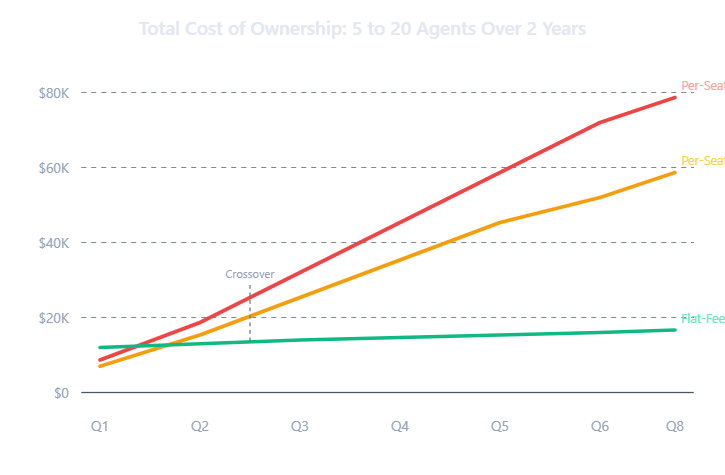
Our finding: We modeled the total cost of ownership over two years for a team growing from a small group to a mid-size operation. On per-seat pricing with AI add-ons, the total spend over that period was roughly three to four times higher than the equivalent flat-fee platform. The gap widened every quarter as the team grew.
The crossover point, where flat-fee becomes dramatically cheaper, arrives faster than most teams expect. For many, it happens within the first year. And once you've crossed it, every agent you add after that is essentially free on the software side.
Want to see what building on a flat-fee model looks like? You can build AI agents without per-seat fees and scale your team without scaling your software bill.
Why Is the Industry Moving Away from Per-Seat Pricing?
The shift away from per-seat pricing is accelerating. Over 40% of companies now use hybrid pricing models, with adoption projected to grow significantly by the end of next year.
AI is the primary catalyst. When AI agents handle tasks that previously required human seats, companies need fewer software licenses. But their output stays the same or increases. A team that had twenty agents might only need eight humans once AI handles the routine queries. Under per-seat pricing, the vendor loses most of that revenue even though the platform is doing more work, not less.
That's why vendors are scrambling. Price increases now account for the majority of go-forward revenue growth at many SaaS companies, not new customers or expansion. They're raising per-seat prices to compensate for the seat compression AI is causing. You're paying more per seat because AI is making seats less necessary. Does that sound like a model designed to help you?
The credit model is one alternative gaining traction. Major platforms like Figma, HubSpot, and Salesforce have all introduced credit systems, with 79 of the PricingSaaS 500 now offering credits, up from 35 a year earlier. Credits give customers some predictability while letting vendors capture value from AI usage. But they add complexity.
For support teams evaluating options now, the question isn't whether per-seat pricing will decline. It's whether you want to be locked into it while the rest of the market moves on. Check out the best AI chatbots for customer service to see which platforms have already made the shift.
How Should You Evaluate Pricing Models Before You Buy?
The right pricing model depends on three factors: your current team size, your growth trajectory, and how much AI you plan to deploy. Most teams evaluate software on features and miss the pricing structure entirely until the first renewal shock.
Before signing any contract, model your total cost of ownership at double your current team size. If the number makes you uncomfortable, the pricing model is wrong for you.
Here's a checklist:
Ask about per-agent add-ons. Some platforms advertise a base price but charge separately for AI features, analytics, or quality assurance per agent. The base price isn't the real price. Ask for the fully loaded cost per agent.
Ask about AI resolution costs. If the platform charges per automated resolution, ask whether there's a cap. Many don't have one. A traffic spike that doubles your bot conversations can double your AI bill overnight.
Ask about contract escalation clauses. Some vendors build annual price increases directly into the contract. If your contract includes a hidden escalation clause, your costs rise even if your team doesn't grow.
Ask what happens when you remove seats. Can you reduce seats mid-contract, or are you locked in until renewal? Flexibility in both directions matters.
Ask about overage billing. Some platforms auto-bill overages without warning. Know exactly what triggers overage charges and whether you'll be notified before being billed.
If a platform can't answer these questions clearly, that tells you something. For a transparent comparison, see how alternatives to per-seat platforms handle these questions.
Frequently Asked Questions
What is the "growth tax" in per-seat pricing?
The growth tax describes how per-seat pricing makes your software cost scale linearly with headcount. Every new agent you hire multiplies your platform bill, creating a financial penalty for scaling support. Seat-based pricing dropped from 21% to 15% of companies in just one year, and 70% of vendors are forecast to move away from pure per-seat by 2028 as alternative models gain traction.
Is flat-fee pricing better than per-seat pricing for customer service software?
For growing teams, flat-fee pricing almost always delivers better total cost of ownership. Your cost stays fixed while your per-agent cost drops with every hire. Per-seat pricing only favors very small teams that plan to stay small. Companies sticking with per-seat for AI products tend to see significantly lower gross margins and higher churn than those adopting usage or outcome-based alternatives.
How much does per-seat pricing really cost as you scale?
The advertised per-seat price is rarely the real cost. Real-world costs are typically two to three times higher once you factor in AI add-ons, analytics, quality assurance, and contract escalation clauses. AI resolution fees alone can run $0.99 per resolution with no cap, and they're auto-billed. A mid-size support operation can reach six figures annually in software costs on per-seat platforms.
Why are SaaS companies moving away from per-seat pricing?
AI is the primary driver. When AI agents handle tasks that previously required human seats, companies need fewer licenses. This collapses seat-based revenue for vendors. Over 40% of companies now use hybrid pricing, with adoption projected to grow significantly by the end of next year. Meanwhile, 79 companies in the PricingSaaS 500 now offer credit models, up from 35 a year ago.
Which customer service platforms offer flat-fee or unlimited agent pricing?
Several platforms now offer flat-fee models with unlimited agents, focusing cost on features or usage tiers rather than headcount. When evaluating, ask specifically about per-agent add-on costs, AI resolution fees, and contract escalation terms to ensure the "unlimited" claim holds up under scrutiny. A good starting point is comparing alternatives to per-seat platforms side by side.
Your Future Starts with a Conversation.
- 30-minute commitment-free call
- Live product demo so you can see how AI customer service helps your business grow
- Discover how we can customize ReplyCX for your industry and business needs
Conclusion
Per-seat pricing was built for a world where more users meant more value. In customer service, it creates the opposite effect. More agents should mean better support. Instead, per-seat pricing makes every new hire a budget negotiation. The advertised price rarely reflects the real cost, AI add-ons compound the gap, and contract escalation clauses ensure you pay more every year, whether your team grows or not.
Flat-fee pricing aligns the incentive correctly. Your cost stays predictable, your per-agent cost drops as you grow, and your finance team never has to recalculate the software budget because you hired two more people. The industry is already moving in this direction, with seat-based models declining and hybrid alternatives surging. Before signing any contract, model your total cost of ownership at double your current team size. If the number makes you uncomfortable, the pricing model is wrong for you.
Stop paying more to serve your customers better. Model your current per-agent costs, calculate what happens if you double your team, and compare that against a flat-fee alternative. The math usually decides for you. Start your free trial and add as many agents as you need without watching the bill climb.
