Seven Common Support Mistakes That Are Costing You Sales
Table of Content


Last year, a B2B logistics platform noticed something strange. New customer acquisition was up 22%, but net revenue barely moved. The marketing team was baffled. The product hadn’t changed. Pricing was competitive. It took a full-quarter audit to find the leak: their support operation was quietly losing nearly as many customers as sales were bringing in. Tickets were falling through the cracks between channels, escalations had no defined path, and pre-sales inquiries on the pricing page went unanswered for hours. The queue looked manageable. The revenue damage was anything but.
That pattern shows up everywhere. Support teams unknowingly repeat the same handful of mistakes, each one silently draining revenue. Not because the agents are bad at their jobs, but because the systems, processes, and priorities around them are broken in ways nobody is tracking.
U.S. companies put nearly $973 billion in annual sales at risk from poor customer experiences. Globally, the figure reaches nearly $3 trillion. Most of the damage is invisible because customers leave without filing a complaint.
This guide walks through seven of the most common support mistakes that cost businesses sales and shows you exactly how to fix each one, starting with the easiest wins
Key Takeaways
What is the biggest support mistake that hurts sales? Slow response times. Most customers buy from the first company that responds, not the one with the best product.
How much does bad support actually cost? Nearly $973 billion in annual U.S. sales are at risk. The damage is mostly invisible because customers leave silently.
Can you fix these mistakes without a huge budget? Yes. Most fixes involve process changes, better routing, and smarter use of automation rather than expensive overhauls.
Which mistake is easiest to fix first? Connecting your support channels into a single inbox. It eliminates dropped conversations and gives agents full context instantly.
Why Do Slow Response Times Kill Sales?
Customers don’t buy from the company with the best product or the lowest price. 75% buy from the company that responds first. That finding flips the way most teams think about support prioritisation.
The gap between what customers expect and what companies deliver is staggering. Customers consider anything beyond a few minutes to be slow. Most companies take hours. Some take days. And a surprising number of inquiries never get a response at all.
This isn’t just a post-sale problem. Companies engaging with leads within the first five minutes are 21 times more likely to qualify them compared to waiting half an hour. When a potential buyer fills out a form and doesn’t hear back quickly, they move on. By the time your team responds the next morning, they’ve already started a conversation with your competitor.
The revenue leak compounds over time. Slow responses don’t just lose the immediate sale. They increase churn, damage your reputation through negative reviews, and create a backlog that makes every future response even slower.
How to fix it: Set up auto-routing to assign conversations to the right agent instantly based on skill and availability. Use AI to handle first responses on routine queries so customers never wait in silence. Explore the best AI chatbots for customer service to find the right fit. Create SLA alerts so no ticket sits unanswered beyond your target window.
What Happens When Customers Have to Repeat Themselves?
Few things frustrate a customer faster than having to explain their problem twice. Or three times. Or starting over entirely because they switched from email to chat.
Only 13% of businesses actually carry customer context across channels. The rest operate in silos. Chat doesn’t know what happened with the email. Phone agents can’t see yesterday's WhatsApp conversation. So the customer retells their story every time they reach out through a different channel.
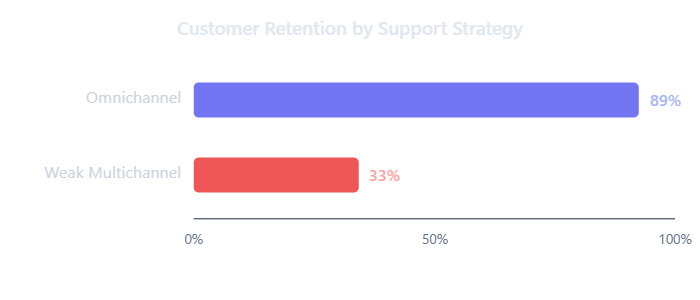
The retention impact is enormous. Brands with strong omnichannel support retain 89% of their customers. Those with weak multichannel strategies retain just 33%. That’s not a marginal difference. It’s the gap between growth and decline.
Our finding: When we audited a mid-market SaaS company’s support operations, we found that context was being lost at every channel transition. Agents were asking customers to “start from the beginning” on nearly every escalated ticket. After unifying their inbox, repeat-information complaints dropped dramatically within the first month.
How to fix it: Connect all your support channels into a single inbox so agents see the full conversation history regardless of where it started. That means email, chat, WhatsApp, SMS, Instagram, and Facebook all flow into one place. Ensure that when a ticket gets handed off to another agent, the full context travels with it automatically.
Are Scripted Responses Costing You, Customers?
Templates save time. That’s why they exist. But when every customer gets the same copy-paste reply regardless of their situation, it stops feeling like service and starts feeling like a wall.
76% of customers expect personalised experiences, and frustration spikes when companies fail to deliver. Every support conversation is a potential upsell, cross-sell, or save moment. When an agent sends a canned reply to a frustrated enterprise customer, they’re not just failing to solve the problem. They’re missing a chance to deepen the relationship and protect the revenue attached to that account.
The difference between good templates and bad templates comes down to flexibility. Good templates provide a starting point that agents customise based on who they’re talking to and what their history looks like. Bad templates are rigid scripts that leave no room for judgment.
How to fix it: Use response templates as starting points, never as final answers. Tag contacts with properties and conversation history so agents can personalize without starting from scratch. AI-optimised replies can generate context-aware suggestions that still sound human, giving agents speed without sacrificing the personal touch.
Are You Losing Deals by Ignoring Pre-Sales Support?
Most companies think of “support” as something that happens after a purchase. But buyers need help before they buy, too, and the companies that engage with pre-sales questions close far more deals than those that don’t.
Companies engaging with leads within the first few minutes are 21 times more likely to qualify them compared to waiting half an hour. Think about what happens on most websites right now. A potential buyer lands on your pricing page with a specific question. There’s no chat widget. Just a “contact us” form that promises a response within one to two business days. By then, they’ve signed up for a competitor’s free trial.
After-hours inquiries are another blind spot. If your buyers are in different time zones or browsing your site in the evenings and on weekends, every unanswered question is a missed opportunity.
How to fix it: Deploy conversational AI or live chat on your highest-intent pages like pricing, product features, and checkout. Build an AI agent for pre-sales that captures leads around the clock and routes hot prospects to sales immediately. For inspiration, explore real-world AI agent use cases that show what this looks like in practice.
What Happens When There’s No Escalation Path?
A customer has a real problem, something that needs judgment and authority to resolve. They start with a chatbot that can’t help. They get transferred to an agent who doesn’t have the permissions. They wait. They get transferred again. Eventually, they give up.
77% of consumers say difficulty reaching a human agent is the single biggest frustration in customer service. Not slow responses. Not wrong answers. The inability to get to someone who can actually help.
This problem intensifies when AI is involved. Chatbots and automated flows are excellent at handling routine queries. But when they hit the edge of their capabilities, and there’s no clear path to a human, the customer experience craters. A bad chatbot dead-end feels worse than never having offered a chatbot at all.
The customers who need escalation tend to be the ones with the most complex, highest-value issues. Enterprise accounts. Multi-product deals. Renewals in jeopardy. When these tickets sit in limbo because nobody has defined the escalation trigger, the revenue at risk is significant.
How to fix it: Define clear escalation triggers based on customer sentiment, topic complexity, and account value. Ensure every automated flow includes a human handoff option that preserves the full conversation context. Create and manage support tickets with priority routing for high-value accounts so enterprise tickets never sit in a general queue.
Are You Tracking the Metrics That Actually Predict Revenue?
Most support teams track ticket volume and average response time. Those numbers are easy to pull and look good in a monthly report. But they don’t tell you whether your support operation is protecting revenue or bleeding it.
The metrics that matter are different. First-contact resolution rate tells you whether customers get their problem solved in one interaction or bounce around for days. The escalation rate reveals whether your routing is working. Customer effort score shows whether the experience felt easy or exhausting.
Traditional post-interaction surveys are nearly useless at this point. Only 3% of customers bother to respond. That means your satisfaction data is based on a wildly unrepresentative sample. You’re making decisions on a sliver of reality.

How to fix it: Track the metrics that matter: satisfaction score, first-contact resolution rate, average resolution time, and escalation rate. Use AI-powered analytics that measure sentiment across every conversation automatically instead of relying on optional surveys. Review agent performance dashboards weekly and look for patterns, not just averages.
What If Support Is Your Biggest Untapped Revenue Channel?
This is the most expensive mistake on the list, and it doesn’t live inside the support team. It lives in the boardroom.
When leadership views support as pure cost, they underinvest. They hire fewer agents. They delay tool upgrades. They skip training. And they measure success by how little they spend rather than how much revenue they generate.
Customer-obsessed organisations grow revenue 41% faster than their peers. That’s not a coincidence. It’s a direct consequence of how they treat the teams and tools closest to the customer. And more than half of consumers cut spending after even a single negative experience.
Every support conversation is a revenue opportunity waiting to be recognised. A customer reaching out about a product issue might be perfect for an upgrade recommendation. A frustrated buyer considering cancellation might stay if the agent has the authority to offer a save. A satisfied customer who just got a fast, personal resolution might refer a colleague.
Our finding: The companies we’ve seen flip this mindset most successfully start by calculating the dollar value of churned customers who cited support as a reason for leaving. That single number, presented to leadership in revenue terms rather than cost terms, tends to shift the conversation immediately.
How to fix it: Reframe support metrics in revenue terms. Calculate the dollar value of retained customers, prevented churn, and upsell conversions that originate from support interactions. Present these numbers alongside cost metrics in every leadership review. Invest in tools that help agents identify and act on revenue opportunities during conversations, not just close tickets.
Support Mistakes at a Glance: Impact, Difficulty, and Quick Wins
What is the fastest way to reduce customer churn from bad support?
Unify your support channels into a single inbox. This is consistently the highest-impact, lowest-effort fix because it eliminates the context loss that forces customers to repeat themselves. Brands with strong omnichannel support retain 89% of their customers compared to just 33% for those with fragmented channels. Most teams can implement this within a week and see measurable drops in repeat-contact complaints almost immediately.
How do I calculate the revenue impact of my support team?
Start with three numbers: the dollar value of customers who churned and cited support as a factor, the average revenue from upsells or cross-sells that originated during support conversations, and the cost difference between retaining an existing customer versus acquiring a new one. Present these alongside your operational costs in every leadership review. Customer-obsessed organisations grow revenue 41% faster than their peers, and framing support in revenue terms is what shifts the boardroom conversation from “how do we cut costs” to “how do we protect revenue.”
What support metrics should I stop tracking?
Not stop entirely, but deprioritise. Ticket volume and average response time are workload metrics, not quality metrics. They tell you how busy your team is, not whether customers are satisfied. Only 3% of customers respond to post-interaction surveys, making survey-based CSAT nearly useless as a standalone measure. Replace dashboard dominance with first-contact resolution rate, escalation rate, customer effort score, and AI-measured sentiment across every conversation.
How do I set up escalation triggers for AI chatbots?
Define three categories: sentiment-based triggers (“escalate if the customer expresses frustration or uses words like ‘cancel’ or ‘speak to someone’”), topic-based triggers (“transfer to sales if pricing or contract terms are mentioned”), and confidence-based triggers (“route to a human if the AI’s confidence score falls below a threshold”). Every automated flow should include a visible, one-click option to reach a human. 77% of consumers say difficulty reaching a human is their top frustration, so the escalation path should be obvious, not buried.
Do these mistakes apply to B2B companies?
Even more so. B2B deals are higher-value, longer-cycle, and involve multiple stakeholders, which means every support failure has an outsized revenue impact. A single unresolved ticket on an enterprise account can jeopardise a six-figure renewal. B2B buyers also have higher expectations for personalised service because they’re paying more and expect a commensurate experience. The seven mistakes in this guide apply universally, but the dollar value at stake per mistake is significantly larger in B2B.
Your Future Starts with a Conversation.
- 30-minute commitment-free call
- Live product demo so you can see how AI customer service helps your business grow
- Discover how we can customize ReplyCX for your industry and business needs
Conclusion
Support mistakes; don’t announce them. They accumulate quietly, each one leaking a little more revenue until the gap between where you are and where you should be becomes impossible to ignore.
Slow responses lose the sale before it starts. Forcing customers to repeat themselves erodes loyalty faster than almost any other friction. Generic scripts miss the personalisation and upsell opportunities hiding in every conversation. And the costliest mistake of all, treating support as a cost centre rather than the growth engine it already is, lives not in the support team but in the boardroom.
The good news is that most of these fixes don’t require a massive budget or a months-long overhaul. Start with the easiest win: connect your support channels into a single inbox and set up basic escalation triggers. Then layer in AI for first responses on routine queries, add resolution-focused metrics to your dashboard, and begin framing support performance in revenue terms for leadership. The impact shows up faster than most teams expect, often within the first few weeks.
Ready to close the leaks? Start your free trial and see what a unified support platform looks like in practice.
