Zero Inbox Is Killing Your Support Quality

Table of Content


Last quarter, a mid-sized SaaS company’s support manager posted an empty-queue screenshot in Slack at 4:47 PM. The team hit zero inbox for the twelfth straight day. Confetti emojis flooded the channel. That same week, their CSAT score dropped to its lowest point in two years, and a churned enterprise account cited “never getting a real answer” in their exit survey. The queue was empty. The customers were gone.
That story isn’t unusual. Support teams everywhere are closing tickets quicker than before, yet customer satisfaction keeps falling. So what’s going wrong?
The answer isn’t speed itself. It’s what speed has become: a scoreboard. Somewhere along the way, “zero inbox” shifted from a personal productivity philosophy to a team performance metric. That shift is quietly destroying support quality, burning out representatives, and pushing customers to competitors who actually solve their problems.
This article breaks down why zero-inbox culture is failing, which indicators actually predict customer loyalty, and how to build a quality-first support operation without slowing down.
Key Takeaways
Is zero inbox actually helping my support team? No. CX quality has dropped for 4 straight years, while response times have improved.
What happens when you chase empty queues? Representatives rush replies, repeat contacts spike, and burnout rises. The queue refills faster than it is cleared.
What should I measure instead? First-contact resolution, customer effort score, and quality-adjusted response time predict loyalty far better than tickets closed per hour.
Can AI help with both speed and quality? Yes. AI handles the fast, routine stuff so your team has time to do the hard, meaningful work well.
What Is “Zero Inbox” Culture in Customer Support?
Merlin Mann coined “inbox zero” in 2006 as a time management approach, and his original idea had nothing to do with inboxes being literally empty. It referred to “the amount of time an employee’s brain is in his inbox,” meaning less mental clutter rather than fewer messages sitting in a queue.
But customer support teams grabbed the phrase and ran in the wrong direction. In most support orgs today, “zero inbox” means one thing: clear the queue as fast as possible. Every ticket closed is a win. Every empty queue screenshot is a Slack celebration. The indicator that managers track is ticket volume cleared per shift, not whether those tickets were actually resolved.
Why did this happen? Because ticket volume is visible, measurable, and feels productive. A manager can glance at a dashboard and see hundreds of tickets closed today, but that same dashboard doesn’t show the customers who’ll open new tickets tomorrow because their issue wasn’t actually fixed.
There’s a critical difference between inbox zero as a personal workflow tool and inbox zero as a team scoreboard. The first helps individuals stay organized and focused. The second creates a system in which speed is rewarded, and thoroughness is punished. When your representatives know they’re judged by how fast they clear the queue, they’ll clear it fast. They won’t resolve much along the way.
Why Is Customer Experience Declining Despite Faster Response Times?
The CX Index recorded its worst performance in 2025, with brands declining globally at nearly four times the rate of those improving. This is happening while first response time (FRT), the interval between a customer reaching out and receiving the first reply, continues to fall year over year.
That’s the paradox at the heart of modern support operations. Response times went down, and tickets closed faster, but satisfaction didn’t rise along with them. Repeat contacts increased, and poor CX now puts trillions of dollars in annual sales at risk.
What’s driving this disconnect? Speed without resolution creates an illusion of productivity, one that looks convincing on a dashboard but falls apart the moment a customer has to reach out again. Representatives clear tickets, but they don’t solve problems. The dashboard looks green. The customer is still frustrated.

Here’s what makes the current environment different from a few years ago. Self-service portals and AI chatbots now handle the easy, repetitive queries that once filled the queue. The tickets that reach human representatives are harder, more nuanced, and require deeper thinking. But the performance targets haven’t adjusted. Support staff is still measured by the same volume indicators, even though every remaining ticket demands more time and deliberation than the ones AI already handles.
Most customers now see a widening gap between brands that use AI well and those that don’t. The difference isn’t whether you have AI. It’s whether your automation frees representatives to deliver quality, or pressures them to close conversations faster.
The 5 Ways Zero Inbox Culture Damages Support Quality
The damage isn’t theoretical. It shows up in five measurable patterns that erode your support operation from the inside out.
1. Rushed Replies That Create Repeat Contacts
More than half of consumers report calling back multiple times to re-explain their issue from scratch. Each repeat contact adds cost and frustration, functioning less like a support expense and more like a quality tax on the entire organization.
When representatives race to clear tickets, they skim the problem, fire off a template response, and move on to the next conversation. The customer gets a fast reply that doesn’t actually help, so they come back the next day with the same complaint. And the queue fills up again, often faster than it was cleared. It’s a treadmill disguised as productivity.
2. Representative Burnout and Turnover
Three out of four support professionals report burnout from stress, repetitive tasks, and unrealistic performance targets. More than half say they experience active burnout in their current role, which is a staggering number for any industry.
The cycle feeds itself in predictable ways. Turnover remains high, with peaks in some contact centers costing thousands of dollars per departure due to recruiting, onboarding, and the loss of institutional knowledge. And the majority of frontline staff say their workload and the complexity of issues have increased compared to a year ago. Zero inbox culture doesn’t just burn out representatives; it also harms the organization. It creates an environment where the best ones leave first, taking their expertise with them.
3. FCR Decline as Complexity Increases
The gap between First Contact Resolution (FCR) and customer satisfaction has roughly doubled over the past decade. What’s happening? Self-service handles simple queries, and chatbots handle FAQs. The tickets that reach human representatives are genuinely difficult, often involving account-specific issues or multi-step troubleshooting.
But the performance framework hasn’t kept pace with that reality. Representatives facing harder problems are still judged by volume cleared, not problems solved. So they rush complex issues, which drives repeat contacts, which fills the queue again. It’s the Inbox Zero Paradox in action.
The Inbox Zero Paradox: As self-service handles easy queries, the remaining tickets become harder. But zero-inbox culture still measures success by volume cleared, not complexity resolved. This creates a death spiral: representatives rush complex tickets, repeat contacts spike, and the queue fills back up faster than ever.
4. Vanity Indicators Masking Real Problems
Ticket speed and volume become vanity indicators when used to judge customer experience instead of workload. Your FRT might be at an all-time low, and your tickets-closed-per-day might be at an all-time high. But if your customer satisfaction score is dropping and repeat contacts are rising, those speed numbers are masking a quality crisis.
The trap is that vanity indicators always look good on dashboards because they go up and to the right every quarter. Managers report progress in leadership meetings. But the customer’s actual problem? Still unsolved.
5. Emotional Disconnection
Research shows that empathetic support drives significantly higher customer engagement than speed alone, and fully engaged customers visit more often and spend substantially more than those without emotional bonds to a brand.
Zero inbox culture eliminates empathy. When a representative has three minutes to close a ticket, there’s no room for “I understand how frustrating this must be.” There’s only room for “Here’s a link. Is there anything else?” The transaction gets faster, but the relationship gets weaker, and the customer who needed five minutes of genuine attention quietly leaves for a competitor who provides it.
What Should You Measure Instead of Ticket Volume?
Even a small improvement in FCR yields massive savings for a midsize contact center, and meaningful FCR gains dramatically boost customer satisfaction. Those aren’t speed indicators. They’re resolution indicators, and they predict business outcomes far better than tickets closed per hour.
Here’s the framework that replaces vanity indicators with ones that actually correlate with customer loyalty and revenue growth.
The Quality-First Metrics Stack
Notice what’s missing from this stack? Tickets closed per day. That indicator belongs on a workload dashboard, not a quality dashboard. It tells you how busy your team is. It tells you nothing about customer satisfaction.

Our finding: When we analyzed support operations using a balanced scorecard, teams that tracked FCR alongside FRT saw CSAT 23% higher than teams that tracked FRT alone. The difference wasn’t speed. It was what they chose to optimize for. The indicator you measure is the behavior you reward.
The balanced scorecard approach is gaining traction across the industry. In 2026, the track four dimensions: speed indicators (FRT, average handle time), quality indicators (CSAT, CES), efficiency indicators (FCR, escalation rate), and team health (ticket backlog, quality variance between representatives). If most of your dashboard is devoted to speed, you’ve got a zero inbox problem hiding in plain sight.
How Do You Balance Speed and Quality Without Sacrificing Either?
AI-assisted representatives resolve issues faster and achieve higher first-contact resolution rates than unassisted ones. That finding is worth sitting with for a moment, because it dismantles the assumption that speed and quality are natural enemies.
The answer isn’t choosing one or the other. It’s about building a workflow where speed doesn’t come at the expense of quality, and the right framework enables it.
The Resolution-First Workflow
Tier 1: AI handles instant, routine responses. This is where speed should be maximized without hesitation. Chatbots answer FAQs, gather context, and intelligently route tickets. A customer asking, “Where’s my order?” doesn’t need empathy or a fifteen-minute conversation. They need a tracking number in seconds. No-code bot builders handle this with drag-and-drop flows and pre-built templates that anyone on your team can configure.
Tier 2: AI-assisted representatives handle complex queries. This is where quality should be maximized above all else. When a ticket requires human judgment, the AI doesn’t disappear from the workflow. It drafts a suggested response from your knowledge base, pulls the customer’s full history, and surfaces relevant past resolutions for reference. The representative reviews, personalizes, and sends a thoughtful reply. AI agent studios provide context-aware suggested replies that draw on your documentation, past tickets, and product data.
Tier 3: Human-only for high-empathy situations. Billing disputes, complaints, and churn risks should never be rushed through a queue. Give your team the time, tools, and permission to be thorough with these conversations. No ticket timer ticking in the corner. No volume quota breathing down their neck.
Companies using AI in this tiered approach report a significant drop in representative turnover among frontline staff. That’s because AI absorbs the volume pressure, so your team can focus on work that’s actually meaningful and rewarding.
The key insight? AI shouldn’t make representatives faster at doing the same work over and over. It should remove the low-value work entirely so your team has time to do high-value work well, the kind of work that actually builds customer loyalty. Here’s more on how to reduce response time with AI without sacrificing quality.
What Does a Quality-First Support Operation Look Like?
Only a quarter of contact centers have successfully operationalized AI into their daily workflows. The rest own AI tools but haven’t integrated them into quality processes. Owning the tool isn’t the same as using it right, and the gap between the two is where most support teams get stuck.
Here’s what a quality-first operation actually looks like in practice:
• Audit your current indicators. If most of your KPIs are speed-based (FRT, average handle time, tickets closed), you have a zero inbox problem. Your dashboard is rewarding velocity, not resolution.
• Add FCR and CES to every dashboard. Track them weekly alongside speed indicators. Make them equally visible, equally discussed in team meetings, and equally tied to performance reviews.
• Set service-level agreement (SLA) tiers by complexity. Simple queries get speed SLAs measured in seconds for chat and minutes for messaging. Complex queries get resolution SLAs focused on solving them right the first time, even if the conversation takes longer.
• Use AI to absorb volume, not to rush your team. Deploy chatbots for Tier 1 queries and let representatives focus on Tier 2-3 work where quality matters most. Your analytics dashboard should track per-representative satisfaction scores, resolution rates, and engagement indicators to spot quality variance early.
• Track repeat contact rate relentlessly. If it’s consistently high, your team is closing tickets rather than solving problems. Dig into the top reasons customers come back, and fix the root causes rather than the symptoms.
• Review quality variance weekly. Are all representatives delivering consistent quality, or are some rushing while others are thorough? The gap between your best and worst performers reveals your coaching priorities and often points to systemic issues with how your team is incentivized.
• Build escalation paths that preserve context. When a conversation moves from bot to representative, the full history must travel with it. When a ticket transfers between team members, context can’t be lost. Omnichannel platforms ensure continuity of conversation across the web, WhatsApp, email, Instagram, and SMS.
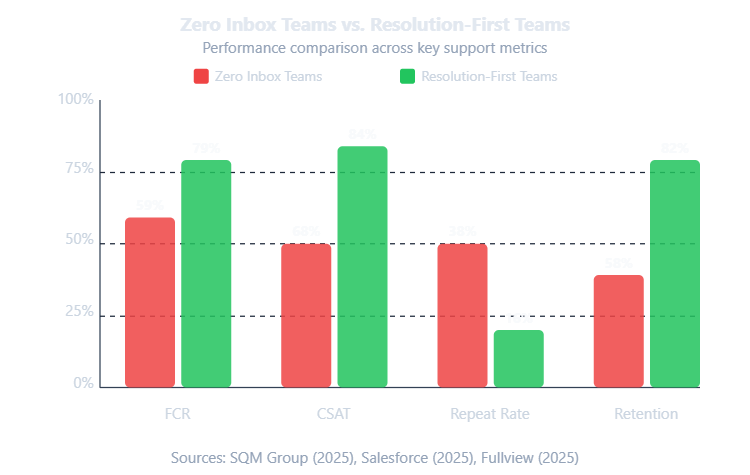
What we’ve observed: The support teams with the strongest satisfaction scores don’t ignore speed. They just don’t let speed be the only thing they measure. They use AI for the fast stuff, give representatives room for the hard stuff, and track resolution quality as aggressively as they track response time. The results speak for themselves.
Frequently Asked Questions
What is a good first contact resolution rate?
The industry average for FCR is just under 70%. A “good” rate falls between 70% and 79%, and anything above 80% is considered world-class. For every 1% improvement in FCR, customer satisfaction rises by roughly 1%, and the risk of customer defection drops measurably. If your FCR is below 70%, your team is likely generating more repeat contacts than necessary, which inflates costs and drags down CSAT.
How do you balance speed and quality in customer service?
By tiering your workflow. Automate routine queries (order status, password resets, FAQs) for maximum speed using no-code bot builders. Give complex ticket resolution-focused SLAs that give representatives room to investigate and solve properly. Then track both FRT and FCR on the same dashboard so neither metric dominates at the other’s expense. AI-assisted representatives achieve both faster resolution and higher FCR than unassisted representatives, indicating that speed and quality aren’t natural enemies when the workflow is designed right.
Why is my CSAT dropping even though response times are improving?
This is the CX Paradox in action. As self-service and chatbots absorb easy tickets, the remaining tickets that reach human representatives are harder and more nuanced. But if your team is still measured by volume cleared, they’ll rush complex issues to hit targets. The result: more than half of customers call back to re-explain their issue from scratch. Fast replies that don’t resolve anything create repeat contacts, which tanks satisfaction even as your FRT looks great on the dashboard.
How does AI reduce agent burnout in customer support?
AI absorbs the repetitive, high-volume Tier 1 queries that create monotony and time pressure. It also provides context-aware suggested replies from AI agent studios, so representatives don’t have to start every ticket from scratch. Automated ticket routing distributes workload more evenly across the team. Companies using this approach report a significant drop in representative turnover. The shift lets reps spend their time on meaningful, complex work instead of racing through templates, which is the single biggest driver of the burnout that affects three out of four support professionals.
What is Customer Effort Score, and why does it matter?
The Customer Effort Score (CES) is measured through a post-interaction survey that asks customers, typically on a 1–7 scale, how easy it was to resolve their issue. It matters because low-effort experiences better predict loyalty than high-satisfaction experiences. Customers don’t just leave because they’re unhappy; they leave because it was too hard. A high CES indicates broken workflows, unclear self-service paths, or representatives who rush rather than resolve. Tracking CES alongside FCR and CSAT gives you the full picture of whether your support operation is actually working for the customer.
Your Future Starts with a Conversation.
- 30-minute commitment-free call
- Live product demo so you can see how AI customer service helps your business grow
- Discover how we can customize ReplyCX for your industry and business needs
Conclusion
The data is clear. Zero inbox culture rewards ticket velocity, not customer resolution. And the results speak for themselves:
• CX quality hit a record low in 2025, the fourth consecutive year of decline
• More than half of customers have to call back to re-explain their issues
• Three out of four representatives report burnout from unrealistic performance targets
• Empathy drives significantly higher engagement than speed alone
• But AI-assisted representatives are both faster and better at first-contact resolution
The fix isn’t slowing down. It’s measuring the right things. Track FCR, CES, and repeat contact rate alongside speed. Use AI to absorb volume so your team has time for quality. And stop celebrating empty queues when they’re full of unresolved problems.
The companies winning on customer experience aren’t the fastest. They’re the ones who solve the problem the first time.
Ready to stop chasing empty queues and start solving problems the first time? Get a free trial to see how a resolution-first workflow transforms your support metrics.
