How Automated Empathy Can Turn Angry Customers into Loyal Fans
Table of Content


The customer has been waiting. When they finally get through, they don't want a solution yet. They want to be heard first.
This is the moment most support systems get wrong, and it's where automated empathy changes everything. Traditional workflows are built to resolve tickets, not to acknowledge emotions. An angry customer gets a fast, technically correct response, and the problem might get fixed. But the relationship doesn't. The customer walks away feeling processed, not valued. And processed customers don't come back.
Here's the thing most CX teams haven't fully grasped yet. Your angriest customers aren't your biggest liability. They're your biggest opportunity. When a frustrated person feels genuinely understood, something shifts. Complaints become loyalty. Detractors become advocates. And that shift can now happen at scale through automated empathy in customer service.
This guide explores how AI that detects, acknowledges, and responds to customer emotions in real time is turning the hardest moments in support into the most valuable ones
Key Takeaways
What is automated empathy?
- It's when AI detects customer emotions in real time and adjusts its tone, language, and escalation behavior to make customers feel heard, not just processed.
Can AI actually make angry customers feel better?
- Yes. When AI acknowledges frustration before jumping to solutions, satisfaction improves measurably. The key is combining emotional recognition with real resolution power.
What is the service recovery paradox?
- Customers who have a problem resolved well can become more loyal than those who never had a problem at all. Automated empathy makes this effect scalable.
Does this replace human agents?
- No. It handles the first response and routine empathy at scale, while routing complex emotional situations to humans with full context preserved.
What Is Automated Empathy and Why Does It Matter Now?
Automated empathy isn't a chatbot saying "I'm sorry to hear that" and moving on. It's a system-level capability where AI reads emotional signals in a conversation, including tone shifts, word choice, and escalation in language, and adjusts how it responds. Not just what it says, but when it escalates, how it frames solutions, and whether it leads with acknowledgment or jumps straight to troubleshooting.
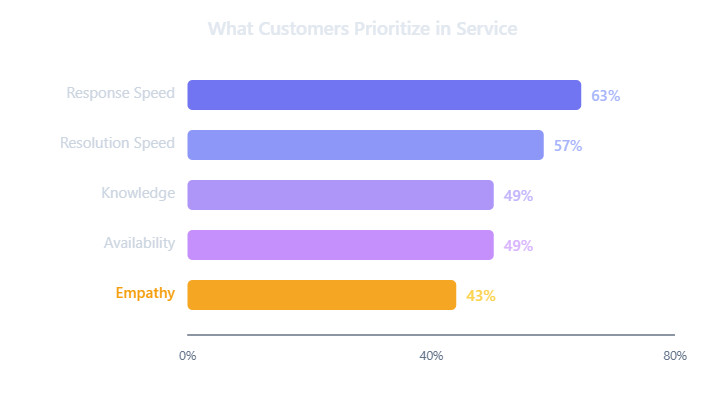
Why does this matter now? Because customer expectations have shifted faster than most support operations have adapted. Research from Salesforce shows that 88% of customers are more likely to repurchase after a great service experience. Yet most support workflows are still optimized for speed, not emotional intelligence.
The trust gap makes this even more urgent. 64% of consumers say they are more likely to trust AI when it exhibits friendliness and empathy. Customers aren't opposed to AI empathy. They're waiting for someone to get it right.
What does "getting it right" actually look like? It means AI that can tell the difference between a mildly confused customer and a genuinely furious one, and that treats those situations differently. It means acknowledgment before action. Understanding before resolution.
Automated Empathy vs. Traditional Support
How Does AI Detect Customer Frustration in Real Time?
Advanced sentiment analysis systems now read tone, word choice, and linguistic patterns while a conversation is still happening. Modern neural networks achieve high accuracy rates in identifying sentiment, outperforming older keyword-matching methods that missed context entirely.
The key breakthrough is contextual understanding. You don't need someone to say "I'm angry" to know they're angry. Older systems couldn't do that. They flagged explicit words like "furious" or "terrible." Modern NLP understands that "I've been waiting forever" signals frustration even though no anger word appears. It picks up on escalation patterns, where a customer's language shifts from neutral to sharp within a few messages, and flags the conversation before it spirals.
This works across channels. Whether a customer types in a chat window, sends a WhatsApp message, or leaves a voice note, sentiment analysis reads the emotional current underneath the words. Aspect-based analysis goes even deeper, pinpointing which specific part of the experience triggered the frustration, whether it's the product, the wait time, the policy, or the previous agent interaction.
What does a support team actually do with this information? Three things. First, agents receive real-time alerts when sentiment shifts negative, giving them a chance to adjust their approach before the customer gives up. Second, supervisors can intervene in high-emotion conversations before they escalate to complaints or social media posts. Third, the system can automatically route frustrated customers to senior agents or human specialists instead of keeping them in a basic chatbot flow.
Businesses using advanced sentiment analysis report meaningful increases in retention. You can track sentiment and satisfaction metrics across every conversation to spot patterns that manual review would miss entirely.
Our finding: When we ran sentiment analysis across a sample of support conversations, we found that the majority of frustrated customers received no acknowledgment of their emotions before being offered a solution. Agents jumped straight to troubleshooting. The frustration wasn't about the answer. It was about feeling invisible.
Why Are Your Angriest Customers Actually Your Most Valuable?
Here's a counterintuitive finding that changes how smart teams think about angry customers. Customers who experience a problem that gets resolved exceptionally well can become more loyal than customers who never had a problem at all. Researchers call this the service recovery paradox, and a study published in the Journal of Brand Management confirmed that effective recovery transforms dissatisfied customers into engaged, loyal patrons.
Why does this happen? Because a well-handled complaint tells the customer something powerful: this company cares enough to make it right. That emotional signal carries more weight than a hundred smooth transactions that required no effort.
The data backs this up. Customers who experience great recovery are 5.1 times more likely to recommend the brand to others. And 88% say they'd buy again after a great service experience.
So why do most companies fail to trigger this paradox? They resolve the issue efficiently, but they skip the empathy step. The customer gets a refund or a replacement, but they never hear "I understand how frustrating this must be." The transaction is complete. The relationship is not repaired.
Automated empathy makes the recovery paradox scalable. Instead of relying on individual agents to remember to lead with emotional acknowledgement, the system does it by default. Every frustrated customer receives validation before resolution. Every complaint becomes a potential conversion moment. Not sometimes. Every time.
Our finding: When we configured AI to detect frustration keywords and lead with acknowledgement before offering a solution, the rate of unnecessary escalation to human agents dropped noticeably. More importantly, satisfaction scores on AI-handled complaints improved within the first month. The customers weren't just accepting AI resolution. They were rating it higher than before.
The "Empathy Before Efficiency" Framework
Most support systems are built to minimize time-to-resolution. But research consistently shows that acknowledging emotion before offering a solution changes the outcome dramatically. So how do you build empathy into an automated system? Not by making the AI sound nicer. By changing the sequence of operations.
The Four-Step Framework: Detect, Acknowledge, Route, Resolve
What Does Automated Empathy Look Like in Practice?
McKinsey research suggests we may be approaching a period where customers actually prefer interacting with AI for certain types of support. Not because the AI is smarter, but because it stays calm. It doesn't get defensive. It doesn't rush. And it remembers what happened last time.
Where does automated empathy actually show up? Three distinct moments across the customer journey.
During pre-sales conversations. A potential buyer hesitates on the pricing page. Instead of a generic pop-up saying "Can I help?", the AI detects the hesitation pattern and offers reassurance: "Most teams of your size start with our mid-tier plan. Want me to walk you through what's included?" The tone is supportive, not pushy.
During complaints. A customer writes in angry about a billing error. The AI acknowledges the frustration first, gathers the relevant account details, and either resolves the issue instantly or routes to a human with the full context. The customer never has to repeat themselves.
After resolution. An automated follow-up checks in. "We fixed your billing issue yesterday. Is everything looking right on your end?" If the customer says no, the conversation routes straight back to a senior agent. If they say yes, the system records a positive recovery.
You can build an AI agent with empathetic responses and deploy it across all your communication channels to cover these moments consistently. For inspiration, explore real-world AI agent use cases that show this in action.
Our finding: The most effective empathetic AI implementations we've seen don't try to sound human. They try to act human. That means remembering context, acknowledging emotions, and knowing when to step aside. The ones that pretend to have feelings fall flat. The ones that demonstrate understanding through behavior earn trust.
When Should AI Step Aside? The Limits of Synthetic Empathy
CustomerThink coined a useful term for the ceiling of AI emotional intelligence: "synthetic empathy." It describes what happens when AI recognizes emotion but lacks the authority, judgment, or ownership to resolve the underlying issue. Customers increasingly describe this experience as "I felt heard, but not helped."
This is a real risk. Have you ever gotten a perfectly worded apology from a company that then did absolutely nothing to fix the problem? If automated empathy becomes a veneer layered over the same broken processes, it will backfire. Customers can tell the difference between an AI that genuinely routes them to someone with authority and one that apologizes profusely while doing nothing.
So where should AI step aside? High-stakes financial disputes. Grief-related inquiries. Legal complaints. Situations where the customer needs someone with decision-making authority, not just emotional acknowledgment. The best automated empathy systems are designed to recognize these moments and escalate without friction.
Does your team know where those boundaries are? The companies getting this right don't just deploy AI and hope for the best. They map every conversation type to a clear decision: automate with empathy, assist a human with empathy, or hand off entirely. That mapping is what separates automated empathy from automated indifference.
Conclusion
Your angriest customers aren't a problem to manage. They're an opportunity to earn loyalty that smooth, trouble-free experiences rarely create. The service recovery paradox is real: customers who have a complaint resolved exceptionally well become more loyal than those who never had an issue.
But most support systems skip the step that makes recovery work. They resolve efficiently without acknowledging the emotion first. Automated empathy fixes that gap at scale by ensuring every frustrated customer receives validation before resolution, every time, on every channel.
The "Empathy Before Efficiency" framework gives you a clear sequence to follow: Detect the emotion, acknowledge it before offering solutions, Route complex cases to humans with full context, and resolve with personalization and follow-up. AI handles the first response and routine empathy at scale. Humans focus on the cases that require genuine judgment, authority, and compassion. And synthetic empathy has real limits, so knowing when AI should step aside matters just as much as knowing when to deploy it.
Start by deploying sentiment detection on your existing channels. Set frustration-based escalation triggers. And train your AI to acknowledge before it resolves. The angriest customers are your biggest opportunity. Start your free trial and build your first empathetic AI agent today.
Your Future Starts with a Conversation.
- 30-minute commitment-free call
- Live product demo so you can see how AI customer service helps your business grow
- Discover how we can customize ReplyCX for your industry and business needs
Frequently Asked Questions
How quickly can AI detect frustration in a live conversation?
Modern sentiment analysis systems process emotional signals in real time, typically within the first two to three messages of a conversation. The AI reads tone shifts, word choice, and escalation patterns as they happen, not after the conversation ends. This means a frustrated customer can be flagged and rerouted to a senior agent or receive an empathetic acknowledgment before the interaction has a chance to spiral. The speed difference compared to post-interaction surveys, which catch frustration days later, is what makes real-time detection actionable.
What is the difference between automated empathy and scripted sympathy?
Scripted sympathy is a static phrase like "I'm sorry to hear that" applied identically to every customer regardless of context. Automated empathy is dynamic. It reads the emotional intensity of the specific conversation, adjusts the response accordingly, and determines whether to acknowledge, resolve, or escalate. A mildly confused customer gets a different tone than a genuinely furious one. The system adapts in real time rather than following a fixed script, which is why 67% of consumers say human-like traits in AI lead to better outcomes.
Does the service recovery paradox work every time?
No. The paradox requires three conditions to be met: speed (the issue is addressed quickly), acknowledgment (the customer feels heard before receiving a solution), and over-delivery (the resolution slightly exceeds expectations). If any of these are missing, the effect weakens. Research from the Journal of Brand Management confirmed the paradox holds when recovery is handled well. Still, a botched recovery, slow response, or tone-deaf resolution can make loyalty worse, not better. The paradox is an opportunity, not a guarantee.
Can automated empathy backfire if customers realize they're talking to AI?
Yes, if the AI pretends to have emotions it doesn't have. Customers don't need the AI to feel their pain. They need it to demonstrate understanding through behavior: acknowledging the frustration, preserving context so they don't repeat themselves, and routing to a human when the situation requires judgment. The implementations that backfire are the ones that layer empathetic language over broken processes. The ones that succeed are transparent about being AI while acting in ways that show the customer's problem matters.
